

Seeing Through the User’s Eyes: Mapping an Airbnb Experience from Start to Finish
By Zoe Kasinskas

Journey maps are visual tools that help designers, marketers, and organizations understand what a user experiences from start to finish when interacting with a product or service. Instead of focusing on the company’s goals, journey maps flip the perspective to reveal what the user is thinking, feeling, and doing at every step.
By mapping out emotions, actions, and touchpoints, organizations can identify where delight happens and where frustration creeps in. As the Nielsen Norman Group explains, journey maps help teams “shed light on key opportunities for deepening relationships” with users by seeing the experience as a story rather than a transaction.
To explore this concept, I created a customer journey map for a scenario that feels both relatable and personal to me: planning a weekend getaway using Airbnb.
The Scenario: Booking a Weekend in Newport, Rhode Island
Meet Emily Carver, a 25-year-old registered nurse from West Hartford, CT. Emily loves her career but often feels the effects of long, exhausting shifts in the hospital. To recharge, she plans short weekend trips with her college friends, often to Newport, RI where they attended college.
Her ultimate goal is to find an affordable Airbnb that captures their college nostalgia while giving her the break she needs. But even a short trip involves a series steps and coordination that can create different emotions, and reveal important design lessons.
Phase 1: Inspiration
The Idea to Reconnect
A photo from college pops up in Emily’s camera roll, bringing a wave of nostalgia. She shares it in the group chat with the message, “We need to go back!” The idea quickly gains momentum.
Phase 2: Research & Discovery
The Search Begins
Emily opens the Airbnb app during her lunch break and begins browsing listings near Newport’s beaches and downtown. She filters by price, beds, and weekend availability, but soon feels overwhelmed. Prices are higher than she remembers, and fees stack up quickly.
This revealed an opportunity to improve fee transparency by showing an estimated per-person total early in search results.
Phase 3: Comparison & Coordination
Group Decisions Get Messy
Emily narrows down three options and sends the links to her friends. Some love one listing, others prefer another, and one friend hasn’t even replied yet. By the time everyone agrees, one of the houses is already booked.
This phase in Emily’s journey presented another opportunity for Airbnb to add shared wishlists and polls directly inside the Airbnb app so groups can vote and finalize faster.
Phase 4: Booking & Payment
Making It Official
Tired of waiting, Emily books the house herself and sends Venmo requests to everyone. She’s excited but also uneasy, fronting over $2,000 and hoping everyone reimburses her promptly.
Another opportunity for Airbnb is to offer a split payment feature at checkout so friends can each pay their portion directly through Airbnb.
Phase 5: Pre-Trip Planning
Anticipation Meets Anxiety
A few days before the trip, Emily receives the host’s check-in instructions and starts planning the itinerary, including dinner reservations, packing lists, and directions. Between late work shifts and group coordination, she’s a little stressed but excited.
Phase 6: Arrival & Stay
The Moment of Truth
Emily uses Google Maps to navigate to the rental and enters the check-in code through the Airbnb app. The moment she walks in, relief washes over her. The house looks even better than the photos. The group spends the weekend revisiting their old campus, spending time at the beach, and dancing late into the night.
Phase 7: Post-Stay Reflection
Lasting Impressions
Back home, Emily leaves a five-star review and uploads photos from the trip to social media. She saves the listing for future visits and texts her friends, “Same weekend next year?”
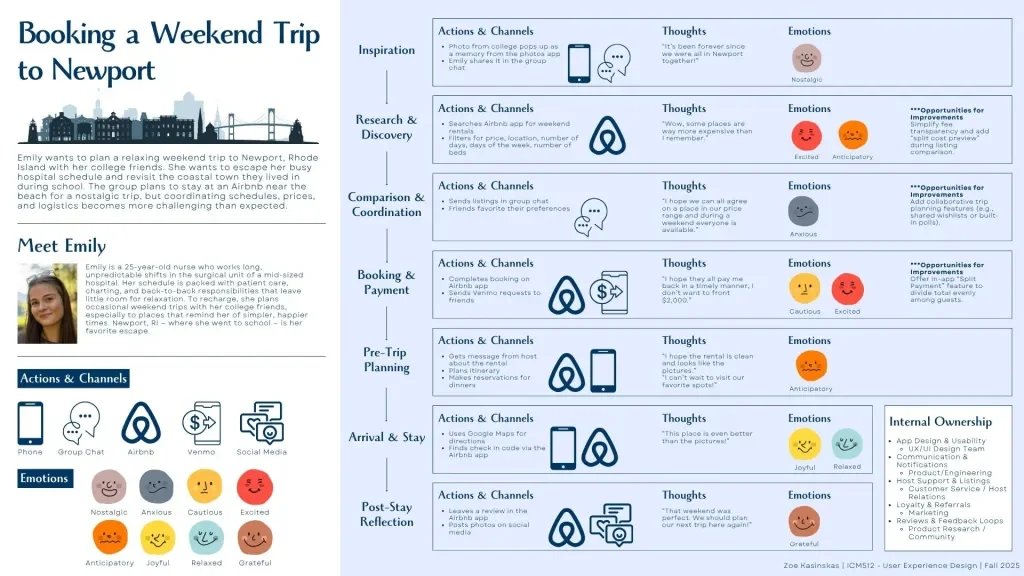
My Journey Map
Aligning Teams Around the User Experience
Journey maps also highlight internal ownership, or the teams responsible for each moment of the user experience. For Airbnb, the improvements in Emily’s journey would involve several departments working together:
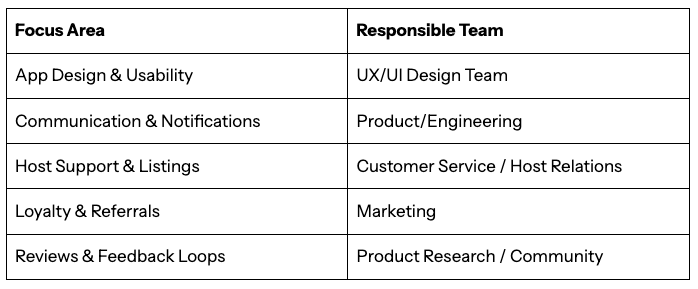
When teams see how their responsibilities connect to real emotions, they can design experiences that not only meet user needs but create memorable, lasting relationships.
What Journey Mapping Reveals
Emily’s experience shows how a product can function perfectly and still leave room for emotional improvement. The process of mapping her journey helped uncover small but meaningful opportunities that could make Airbnb more intuitive, collaborative, and empathetic.
Journey mapping, at its core, is about seeing through someone else’s eyes. It helps teams move from data to empathy, from assumptions to understanding. Every touchpoint tells a story, and every story reveals a chance to design something better.
10/11/25